
How to Search Criminal Dockets
Begin with whatever paper you already have. A notice, warrant, citation, or old filing names the court. That tells you where to look. The Circuit Clerk holds Circuit and District criminal records alike, and a municipal case stays with the city that issued it. For a free orientation, the Shelby Docket List shows public dates and lists. Alacourt/Just One Look offers paid subscriber access. It reaches fuller case action summaries and available images. An empty result screen proves nothing. It may simply point to the wrong court, an old record, a spelling issue, a restricted case, or limits in the public list.
Always use the full case number when you have it. Alabama prefixes tell you the court level. CC-YYYY-NNNNNN is commonly Circuit criminal, DC-YYYY-NNNNNN District criminal, and TR-YYYY-NNNNNN traffic. Never reconstruct missing digits. Use exactly the number the court printed.
AlaFile is the statewide filing system behind the electronic case file. It needs proper filing credentials or registration, so it is not the ordinary public reader.
- Confirm whether the case is in Circuit Court, District Court, or a municipal court.
- Try the Shelby Docket List for the relevant date and docket list.
- Use Alacourt with the exact case number, or a name plus year and case-type filters.
- Match the court, filing date, status, and charge before opening a result.
- Ask the Circuit Clerk for a specific order or certified copy when the image is absent.
Shelby County Criminal Docket Number Path
One Shelby County felony can carry more than one criminal docket number. The case often begins in District Court with a complaint or warrant. That court handles the initial appearance, bond, and a preliminary felony stage. After indictment, the felony moves into the 18th Judicial Circuit. It picks up a Circuit criminal number there. Keep both identifiers. A transfer or cross-reference entry ties the records together. But the District and Circuit histories are separate files, not one continuous page.
Shelby County docket flow: Complaint or Warrant › District Court Stage › Indictment › Circuit Court Number › Plea or Trial › Judgment and Sentence.
State misdemeanors stay in District Court. City ordinance charges and municipal traffic matters remain with the issuing municipal court unless an appeal creates a Circuit Court entry. Checking venue first prevents the most common failed search.
What a Criminal Docket Shows
The case action summary is a chronological index, not always the full case file. Its header names the court and the case number. It also lists the filing or indictment date, the judge, and the status. Separate blocks may cover the State of Alabama and defendant roles, attorneys, charge counts, settings, disposition, and financial entries. Read each dated action in order. A filing description only reports that an event occurred. The attached image, signed order, or judgment supplies the operative text.
| Case number | A Circuit, District, or traffic identifier such as CC-YYYY-NNNNNN. |
|---|---|
| Charge block | Count, offense description, code section, classification, and count-specific result. |
| Case actions | Complaint, bond, counsel, indictment, plea, motion, order, continuance, trial, and appeal entries. |
| Settings | Date, time, setting type, judge, and courtroom when entered. |
| Outcome and money | Disposition, sentence, fines, costs, payments, balance, and bond information where public. |
Restricted identifiers and sealed, juvenile, or youthful-offender material stay closed. An event appearing on the docket does not make it public.
Shelby County Criminal Docket Charge Blocks
Read a Shelby County criminal docket count by count. A status like active or disposed summarizes the whole file, but it cannot replace the result on each individual charge. One count may show a plea or conviction while another shows dismissal, acquittal, nolle prosequi, or another lawful outcome. "Nolle prosequi" means the prosecution formally chose not to proceed on that charge, subject to the governing law and court action.
- Motion filed
- A party asked the court to act. The request has not necessarily been granted.
- Order
- The judge directed or ruled on a matter. Read the signed text when the exact effect matters.
- Disposed
- The main case reached a result, though costs, review, an appeal, or another later entry may remain.
- Continuance
- A setting moved after court action. A request alone does not change the date.
The newest order controls over a short event label. If the docket lists only a title, request that exact filing by its date and description.
Stages on a Criminal Docket
A Shelby County criminal docket may open with a complaint, warrant return, initial appearance, counsel entry, and bond. A felony then shows indictment, arraignment, discovery notices, pretrial motions, orders, and settings in Circuit Court. A misdemeanor usually stays in District Court. The record may close with a plea or trial. Then come a count-specific disposition, judgment, sentence, costs, a post-judgment motion, or an appeal notice.
Docket flow: Filing › Arraignment › Pretrial › Plea or Trial › Disposition › Sentencing.
Settings can repeat, so read forward after each reset. A filed motion to continue does not prove the judge granted it. Locate the later order or notice, and confirm any urgent date with the criminal division.
Shelby County Criminal Docket Desk
The most direct local fallback is the District/Circuit Criminal and Traffic division at 205-670-5266. The Circuit Clerk's public counter sits in Room 1F of the Shelby County Courthouse, 112 North Main Street, Columbiana, Alabama 35051. Hours run Monday through Friday, 8:00 a.m. to 4:30 p.m. The counter stays open at lunch. For mail, use P.O. Box 1810. Send it to Columbiana, AL 35051.
Circuit Clerk of Shelby County
112 North Main Street, Room 1F
Columbiana, AL 35051
205-669-3760
Criminal and traffic division: 205-670-5266
Criminal appeals and bookkeeper: 205-670-5269
Bring the case number, court level, and the exact item you want. For an older or non-imaged record, add a party name, approximate year, and case type. The official division directory also lists staff email routes. Ask whether the source is electronic, paper, or archived. Get a cost quote before copies are made.
Which Court Holds Criminal Dockets
The 18th Judicial Circuit Court holds Shelby County felony dockets after indictment. Shelby District Court handles misdemeanors, preliminary felony proceedings, and state traffic cases. One Circuit Clerk office maintains both sets of records. The split is about court level, not two county clerks. City ordinance and municipal traffic cases sit with the city clerk. Probate Court keeps no ordinary criminal dockets.
| Matter | Court | Record route |
|---|---|---|
| Felony after indictment | 18th Judicial Circuit | Shelby Circuit Clerk and Alacourt |
| Felony preliminary stage | District Court | Shelby Circuit Clerk |
| State misdemeanor | District Court | Shelby Circuit Clerk |
| City ordinance case | Issuing municipal court | That city's clerk |
Write down both case numbers when a transfer or appeal starts a new file. The Circuit docket covers a later stage, while the original lower-court record still tells its own part of the story.
Shelby County Criminal Docket Bookkeeping
Money leaves a trail of its own. The Shelby criminal bookkeeper page walks through that side of a criminal case. That means cash bonds, court costs, fines, and drug-court supervision funds. Entries like these can land on a Shelby County criminal docket. They may appear after the main charge is disposed. So a "disposed" status does not close every bookkeeping item. Some payments or reviews still run afterward, and the ledger catches them.
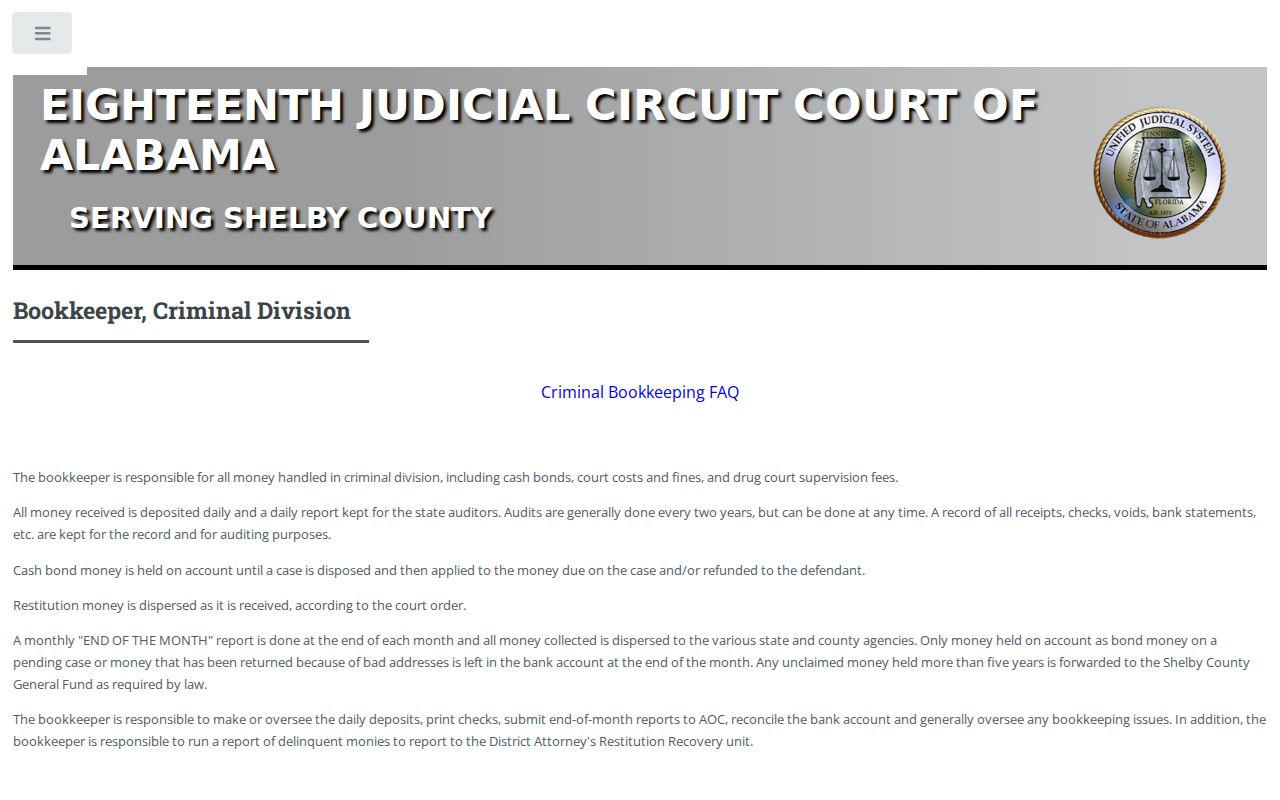
The official page helps you split two things apart. One is the outcome of the charge. The other is the bond and payment ledger, where cash bond may sit until disposition and then be applied or refunded.
Call the Shelby criminal appeals and bookkeeper line at 205-670-5269 with an appeal-related payment or ledger question. Staff can explain procedure and where a record lives. They cannot give legal advice.
Shelby County Criminal Docket Resets
A reset never wipes the old date away. The Shelby County criminal docket keeps it. To find the current setting, look for the newest notice, setting entry, or signed order. Be careful with "Motion to continue filed." That line only proves someone asked for more time. The change becomes real through an order granting the motion or a later setting entry, and a case action summary may preserve every prior date, which is useful history but can confuse anyone who stops at the first match.
If dates conflict: compare the latest signed notice and newest docket entry, then call 205-670-5266 with the exact case number.
Two broader tools exist. The published annual court calendar and any judge-assignment order handle scheduling across the whole court. Neither one replaces an individual hearing notice. For help comparing those sources, see the full Shelby County court calendar process.
Shelby County Criminal Appeal Dockets
For appeals, start local. The Circuit Clerk's criminal appeals page is the official entry point. It covers appeal procedure and bookkeeping in Shelby County. After sentencing, a criminal docket may pick up an appeal notice, a post-judgment motion, or an appellate cross-reference. Read those entries after the disposition. The case did not necessarily end at the first judgment line.
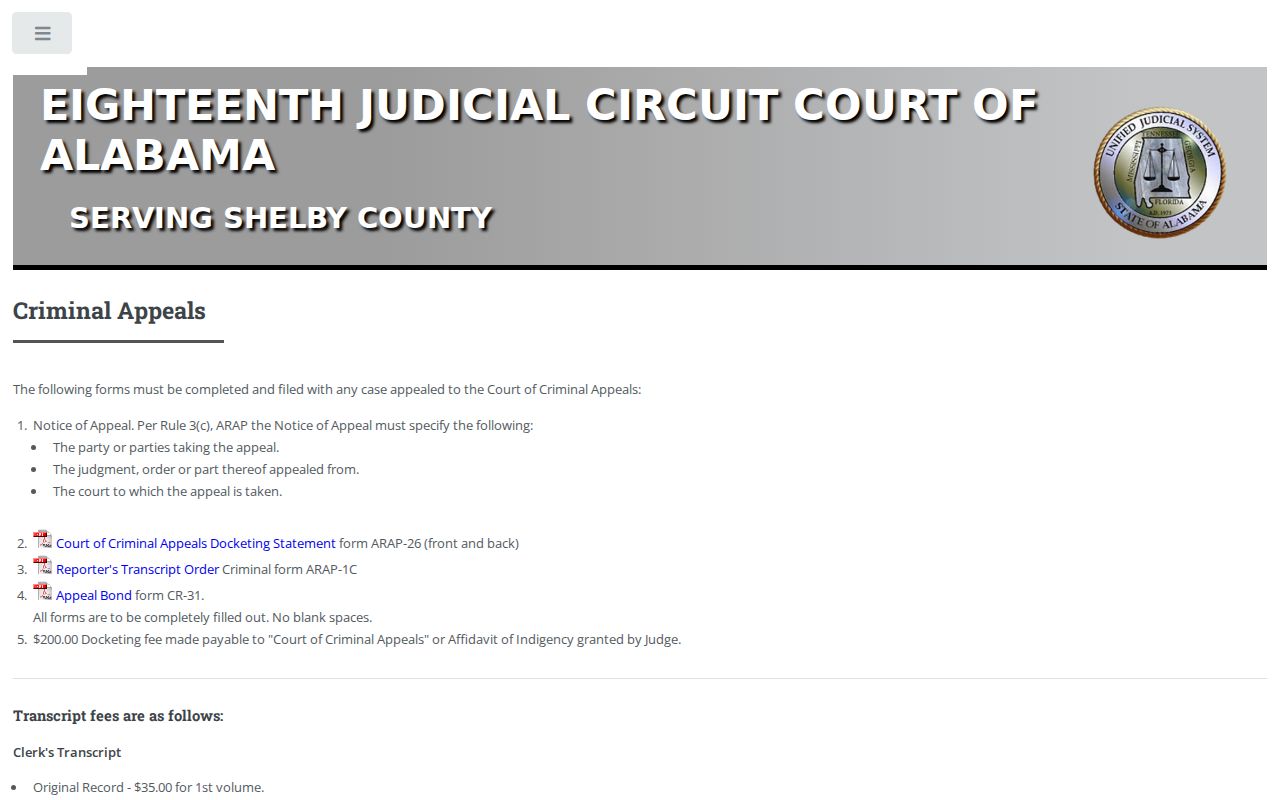
The clerk runs criminal appeals as a separate function. Alabama criminal appeals go to the Alabama Court of Criminal Appeals. The Shelby clerk, in turn, keeps the trial-court record that gave rise to the appeal.
Shelby County Criminal Docket Orders
Motions and orders sit apart on a Shelby County criminal docket. The split matters. A suppression motion, bond request, or continuance request is just that: a request for a ruling. The order that follows states what the court actually did. When the docket lacks the image itself, note the entry date and title. Then request that one document from Room 1F or through the official court-record copy form.
Before any of that, the Shelby magistrates and warrants page explains the local warrant function that can feed the earliest District Court entries.
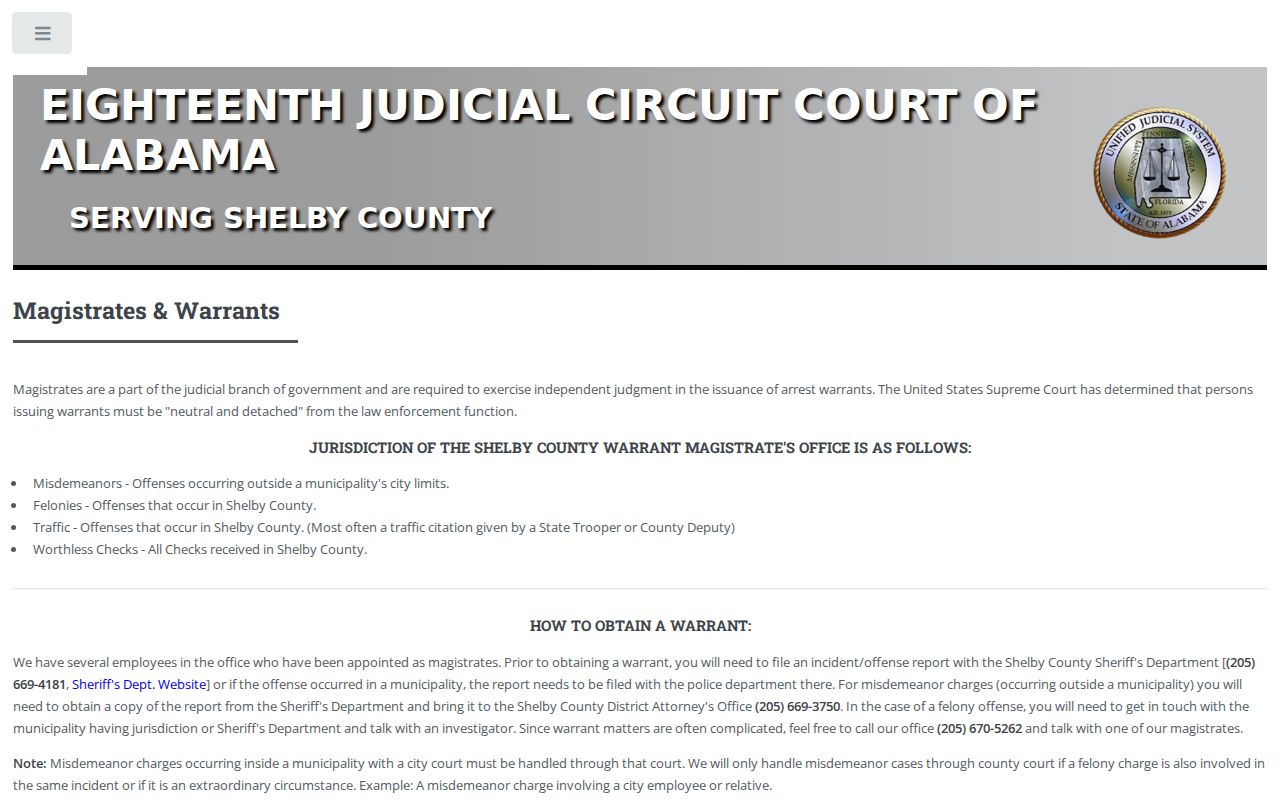
A warrant sits at the start of the criminal process. Do not confuse it with the later judgment, sentence, or certified disposition.
Public Access and Sealed Criminal Dockets
Who may see a Shelby County criminal docket? Judicial rules, statutes, and court orders decide. Alabama Rule of Judicial Administration 16 covers inspection, copies, and charges for court records. Alabama Code Section 36-12-40 adds a broader public-writings rule, though exceptions apply. Juvenile records, expunged matters, youthful-offender material, some warrant information, grand-jury material, and sealed exhibits can all be restricted.
Key rules:
Alabama Rule of Judicial Administration 16 governs court-record inspection, copying, and related charges.
Alabama Code Section 12-15-133 restricts access to juvenile legal and social records.
Alabama Code Title 15, Chapter 27 governs criminal-record expungement.
A public event does not promise a public attachment. Redaction is not the same as sealing the whole case. If access is denied, ask which rule applies and whether a redacted copy or docket-only extract exists.
Shelby County Criminal Docket Expungement
Dismissal is not expungement. A dismissed or nolle-prossed charge keeps its case action history. That history stays in place unless a qualifying petition is granted under Alabama law. Shelby publishes a dedicated expungement filing page. Eligibility there turns on Title 15, Chapter 27 and the facts of the case. One caution: a missing entry in an ordinary public search tells you nothing about why it is missing.
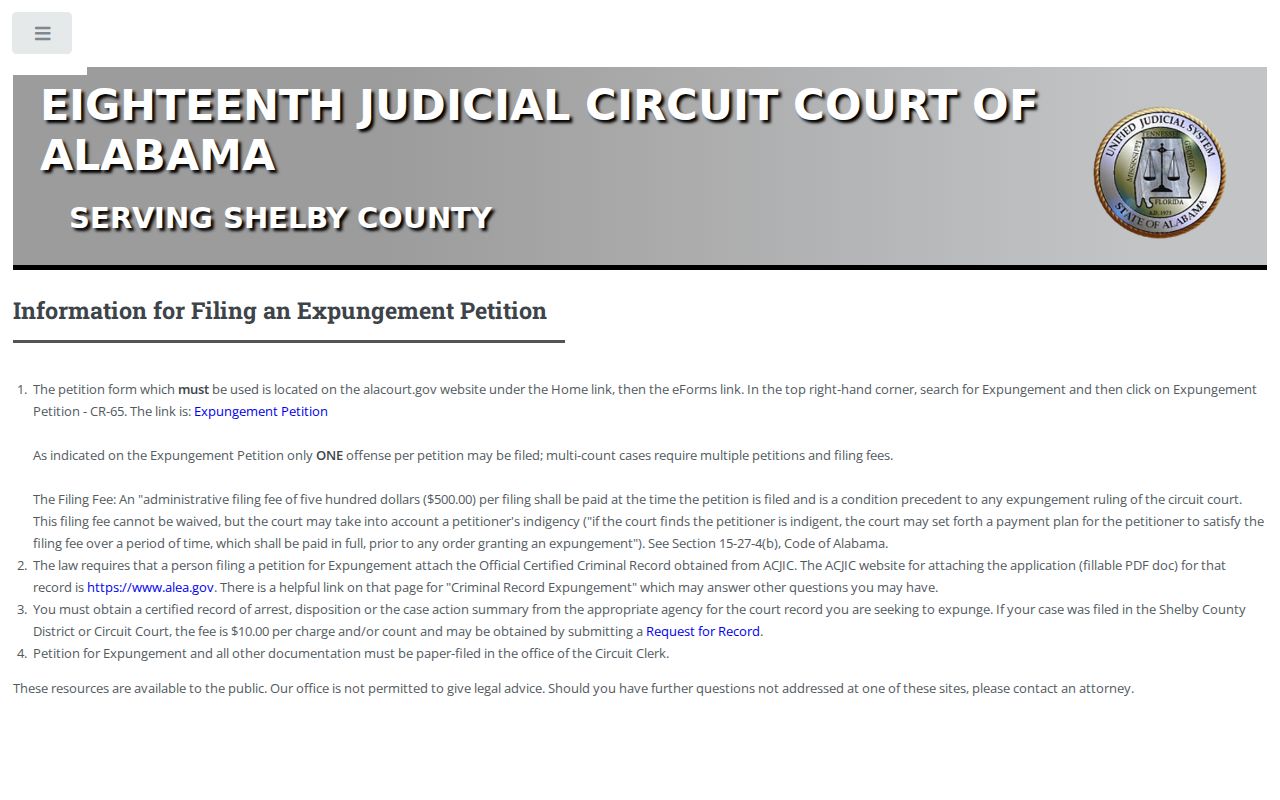
Restricted access follows a formal statutory process, as the clerk's expungement source shows. An acquittal, dismissal, or completed sentence does not trigger it automatically.